Find a missing side without mixing up the hypotenuse
Know two sides but need the third? Find the right angle first: it tells you which side is the hypotenuse and whether to add or subtract the squares.
Start at the little square, not the sloping line
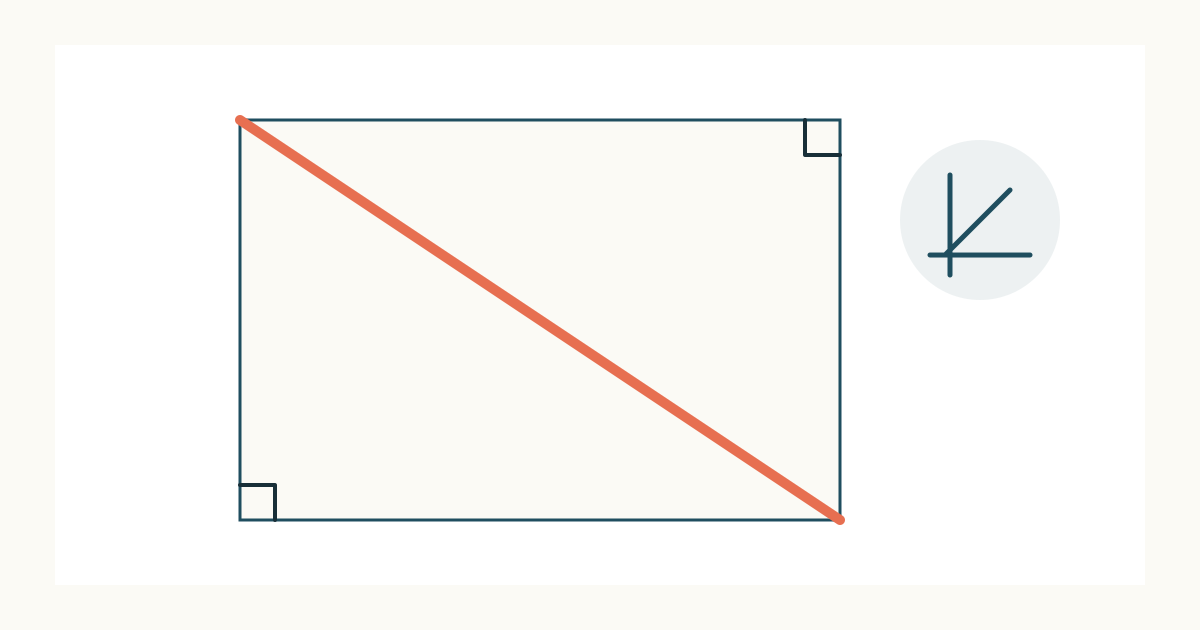
I look for the right-angle marker first. The two edges meeting there are the legs. The edge facing that marker is the hypotenuse, and it must be longer than either leg. Drawings can be rotated, stretched or not to scale, so visual slope is a poor guide. A horizontal edge can be the hypotenuse if the right angle is elsewhere. Mark the unknown with a question mark before reaching for a formula.
If the problem does not establish a right angle, stop at that assumption. Three lengths can be checked for consistency with a right triangle, but two lengths alone do not determine the third side of an arbitrary triangle. A sketch that merely resembles a right triangle is not enough. The OpenStax geometry chapter identifies the hypotenuse as the side opposite the right angle. This definition is more useful than memorizing where c appears in a particular drawing.
Choose the operation from the unknown side
| Known lengths | Unknown | Equation |
|---|---|---|
| Two legs a and b | Hypotenuse c | c = √(a² + b²) |
| Hypotenuse c and leg b | Leg a | a = √(c² − b²) |
| Hypotenuse c and leg a | Leg b | b = √(c² − a²) |
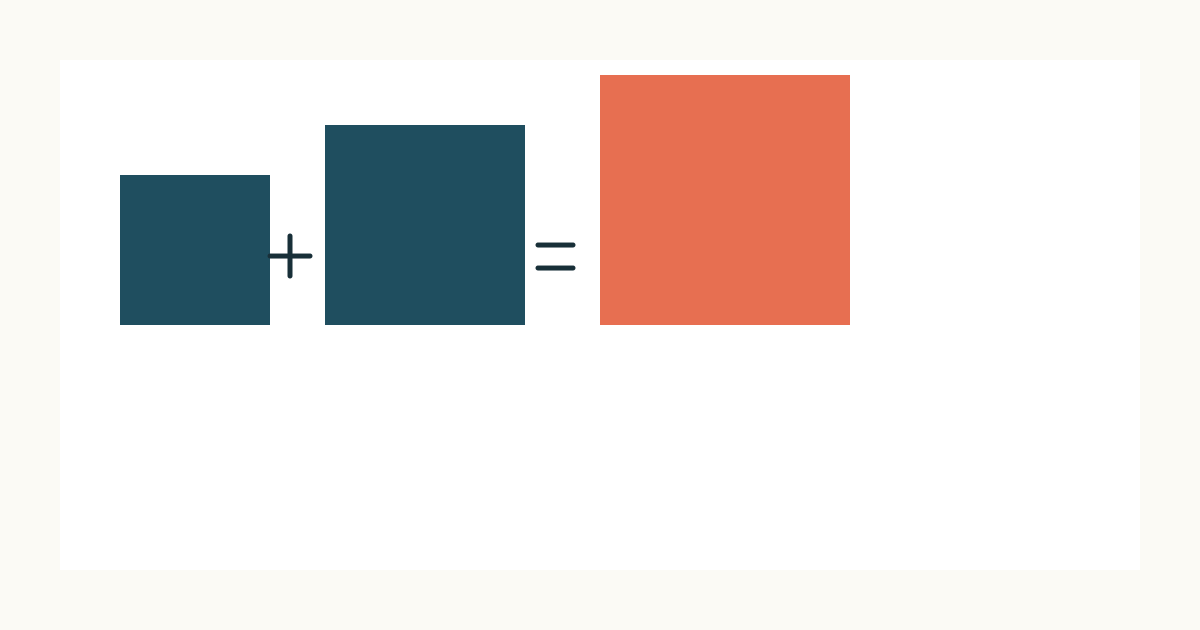
The unknown hypotenuse receives the sum of the two smaller square areas. The unknown leg receives what remains after the known leg square is removed from the hypotenuse square. I keep this rearrangement in words: it prevents the common mistake of subtracting the two plain lengths. The quantities under the root are areas, while the answer after the root is a length.
Only the positive root belongs to a physical length. An algebraic equation x² = 25 has solutions x = 5 and x = −5, but a triangle side is positive, so its length is 5. A zero answer gives a collapsed shape, not a right triangle with three genuine sides. If the hypotenuse input is no greater than the known leg, revisit the labels before doing any further arithmetic.
A decimal diagonal, worked without early rounding
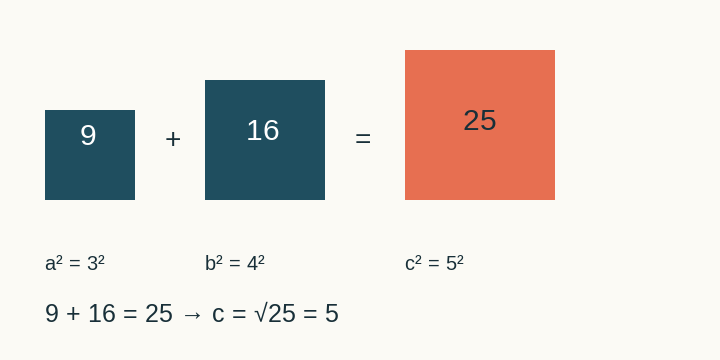
Suppose the perpendicular legs are 7.2 cm and 9.6 cm. Write c = √(7.2² + 9.6²). Squaring gives 51.84 and 92.16; adding gives 144. The root is 12, so the hypotenuse is 12 cm. Checking backwards, 12² = 144 and 51.84 + 92.16 = 144. This example is a scaled 3–4–5 triangle: multiply each basic side by 2.4.
The accompanying geometry results describe the same right triangle. Its area is 7.2 × 9.6 / 2 = 34.56 cm², perimeter is 7.2 + 9.6 + 12 = 28.8 cm, and altitude to the hypotenuse is 7.2 × 9.6 / 12 = 5.76 cm. Keep the square on the area unit. A perimeter cannot be in square centimetres, and an area cannot be in ordinary centimetres. These unit checks often catch a transcription error before the final numerical check does.
A missing leg, with the longest side kept in place
Take c = 13 and b = 12. Start from a² + 12² = 13², then isolate a² = 169 − 144 = 25. Taking the positive square root gives a = 5. Compare that with 13 − 12 = 1: the latter is simply the difference between two lengths and does not obey the theorem. The correct result gives 5² + 12² = 25 + 144 = 169.
A useful second example has c = 10 and a = 7. Then b = √(100 − 49) = √51 ≈ 7.1414. There is no reason to expect a whole-number answer. Retain √51 in symbolic work or keep the unrounded calculator value until the last step. If you round b to 7.14 and then square that rounded value, you obtain 50.9796, not exactly 51. That discrepancy comes from display rounding, not from a different triangle.
Entering the problem without changing it
In the Pythagorean theorem calculator, Auto detects which field is empty. Explicit side modes make the unknown field read-only and ignore its stored value. The result is shown separately; it is never written back as a rounded input. This makes it easier to change decimal places or output units without gradually altering the original problem.
If all three boxes are filled, Auto performs a check instead of solving for c. For inputs 3, 4 and 6, the tool keeps the 6 and reports that the lengths are not right within its numerical tolerance. Erase the third value only when you genuinely intend it to be unknown. Saving a comparison stores the source inputs locally, and restoring it recalculates them. CSV records those inputs, rather than a hidden precision-reduced copy of the answer.
A five-step review before you submit
- Mark the right angle and identify the opposite side as c.
- Put the known lengths into a shared unit, or label each physical unit in the tool.
- Choose addition for c and subtraction for a leg.
- Keep the intermediate squares and root unrounded.
- Check that c is longest and that the squared relationship matches.
For mixed inputs of 0.3 m and 40 cm, conversion produces legs 0.3 m and 0.4 m, then c = 0.5 m. Adding 0.3² to 40² before conversion combines incompatible units and solves a different problem. The exact-root guide explains why some answers simplify and others remain irrational. For measurements taken from a frame or panel, the diagonal guide separates ideal geometry from uncertainty. A calculation can verify the arithmetic you entered; it cannot verify the corner or the measuring technique by itself.
Questions and answers
Can the missing side be the hypotenuse?
Yes. With two known legs, add their squares and take the positive square root.
Why is my answer not a whole number?
Most positive side pairs do not belong to an integer triple. An irrational root is a valid length.
Should I enter a previous answer in the empty box?
Leave it empty when solving. Three supplied values trigger a consistency check in Auto mode.