Pythagorean triples, exact roots and decimal answers
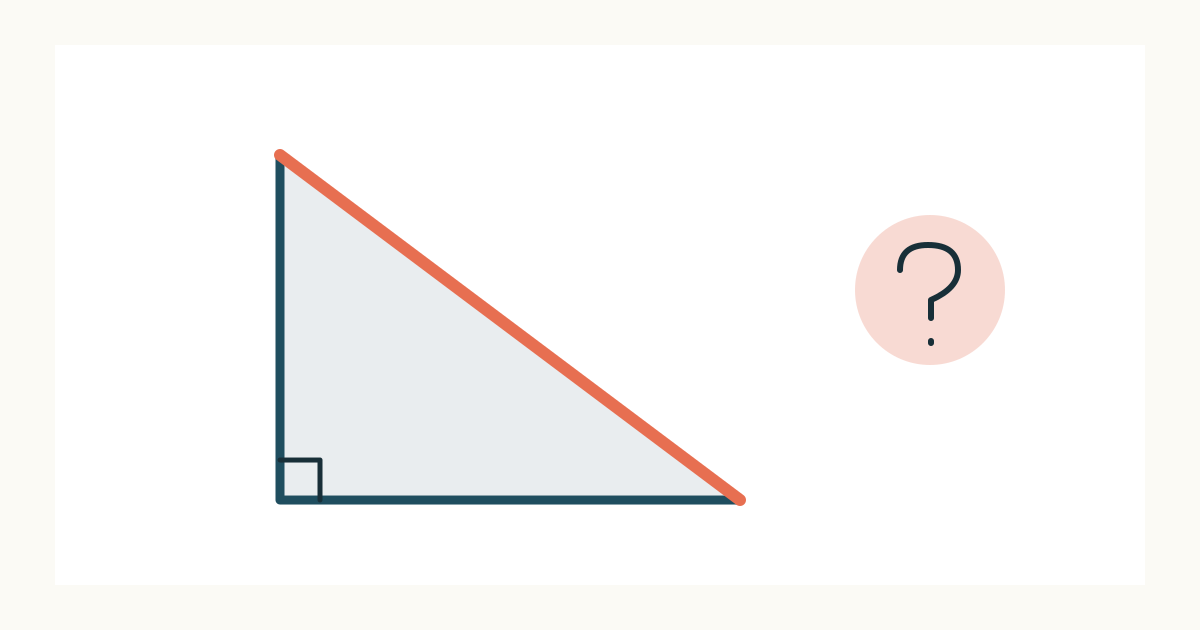
Legs of 5 and 12 give a hypotenuse of 13. Change the 12 to 11 and the answer becomes √146. Recognizing a triple helps, but the actual numbers decide the answer.
What makes three integers a triple?
A Pythagorean triple is a set of three positive integers satisfying a² + b² = c². The smallest familiar example is 3, 4 and 5 because 9 + 16 = 25. The word integer matters: a right triangle with legs 1 and 1 is perfectly valid, but its hypotenuse is √2, so those three lengths are not an integer triple. The theorem describes all right triangles; triples describe a special arithmetic subset.
I use triples to check a calculation, not to force an answer into a familiar pattern. If a problem gives legs 5 and 12, recognizing 13 is convenient. If it gives 5 and 11, the hypotenuse is √146 ≈ 12.0830, and substituting 13 would change the problem. First square the actual inputs. Pattern recognition is a shortcut only when it agrees with those inputs.
A small reference set with checked squares
| Legs | Square sum | Hypotenuse |
|---|---|---|
| 3, 4 | 9 + 16 = 25 | 5 |
| 5, 12 | 25 + 144 = 169 | 13 |
| 8, 15 | 64 + 225 = 289 | 17 |
| 7, 24 | 49 + 576 = 625 | 25 |
| 20, 21 | 400 + 441 = 841 | 29 |
Multiplying all three sides by the same positive scale preserves the equation. Starting with 3–4–5 and multiplying by 2 gives 6–8–10. Multiplying by 0.1 gives 0.3–0.4–0.5, which is still a right triangle but is no longer an integer triple in those units. The angles remain unchanged because the ratios of the legs remain unchanged. Perimeter grows by the scale factor, and area grows by its square.
A primitive triple has no common integer factor greater than one. The 3–4–5 and 5–12–13 examples are primitive, while 6–8–10 shares the factor 2. This is an arithmetic description, not a claim that one triangle is more geometrically right than another. Both satisfy the same 90° relationship. Changing the unit can also change whether the displayed lengths happen to be integers.
Generate a family, then verify it
One useful construction is a = m² − n², b = 2mn and c = m² + n² for integers m > n > 0. Taking m = 3 and n = 2 produces a = 9 − 4 = 5, b = 12 and c = 13. The identity follows by expanding the squares: (m² − n²)² + (2mn)² = m⁴ + 2m²n² + n⁴ = (m² + n²)².
For m = 4 and n = 1, the lengths are 15, 8 and 17. Their order does not matter for the two legs, but the largest value must remain the hypotenuse when you solve. The formula can produce nonprimitive triples too. With m = 3 and n = 1, it gives 8–6–10, which reduces to 4–3–5. I still check the squared sum after generating a family; it is an inexpensive way to catch a wrong sign or a missing factor 2.
Simplify the root without changing its value
For legs 3 and 6, c = √(9 + 36) = √45. Factor the radicand into 9 × 5. Because √9 = 3, the result is 3√5. The decimal value is approximately 6.7082. The exact form keeps the full mathematical value, while the decimal is a rounded representation. Writing √45 and 3√5 describes the same length; writing 6.71 describes a nearby decimal approximation.
Another example is √72 = √(36 × 2) = 6√2. You can also extract factors in smaller steps: √72 = √(9 × 8) = 3√8 = 3 × 2√2. What you cannot do is distribute a square root over addition. √(9 + 16) is 5, whereas √9 + √16 is 7. A square factor can leave a product under the root, but an arbitrary sum does not split into independent roots.
| Radicand | Exact root | Approximation |
|---|---|---|
| 2 | √2 | 1.4142 |
| 45 | 3√5 | 6.7082 |
| 51 | √51 | 7.1414 |
| 72 | 6√2 | 8.4853 |
Why a rounded answer may fail an exact check
With equal legs of length 1, the exact hypotenuse is √2. Rounded to two places it is 1.41, whose square is 1.9881 rather than 2. If you enter 1, 1 and 1.41 in a three-side checker, a strict numerical test can therefore fail. This does not contradict the theorem. You replaced the exact root with a rounded measurement-like value before checking it.
I retain the radical during symbolic work and round the final practical answer only to the requested precision. More displayed decimal places do not make an uncertain measurement more accurate. The calculator does not write its rounded answer into an input field, so switching display precision leaves the underlying source values unchanged. Exact simplification requires integer known sides after unit conversion and a positive integer radicand up to 100,000,000; outside that range the numerical result still works, but the tool does not claim an exact factorization.
A short practice routine with independent checks
- Square the actual legs before deciding that they match a known triple.
- Look for a perfect-square factor in the sum or difference.
- Keep the simplified radical as the exact answer.
- Calculate a decimal only after the exact form is settled.
- Substitute the unrounded value into the original relationship.
Try legs 20 and 21: 400 + 441 = 841, so c = 29. Then try 2 and 3: 4 + 9 = 13, so c = √13 ≈ 3.6056. The second pair is no less valid as a right triangle; it simply lacks an integer hypotenuse. Save both in the local comparison history to see how the displayed root changes while the theorem stays the same. For choosing which side to isolate, use the missing-side decision guide. For dimensions taken from an object, consult the measurement discussion before interpreting a small difference as proof of a physical angle.
Questions and answers
Are all right triangles Pythagorean triples?
No. A triple requires all three lengths to be positive integers in the chosen common unit.
Is 6–8–10 a primitive triple?
No. It has a common factor 2 and reduces to 3–4–5. It is still a right triangle.
Can I split √(a² + b²) into a + b?
No. Square roots do not distribute over addition. For 3 and 4, the correct root is 5 rather than 7.